
 | marketing@wsdks.com |  | +8617712621386 |  | No. 8 Jinwei Road, Changshu City, Jiangsu Province, P.R.China |


ZLD Process: Pretreatment to Crystallization
A ZLD process is a chain of treatment decisions, not a fixed equipment package. Feed characterization defines pretreatment; pretreatment protects concentration; concentration reduces the thermal load; evaporation and crystallization separate water and solids; and every outlet must have a verified destination.
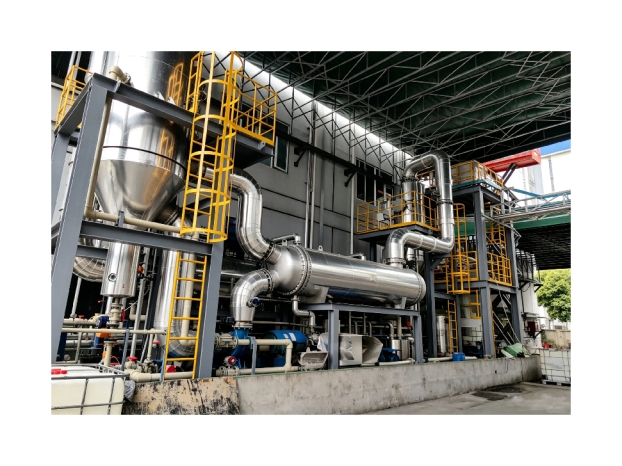
The ZLD process starts before the first treatment unit. It starts with a boundary, a water balance, and representative data for every wastewater stream included in that boundary. Organizations evaluating zero liquid discharge solutions should therefore ask how each stage changes flow, composition, operating risk, and the requirements of the next stage.
ZLD process design begins with the design basis
A credible design basis defines the feed streams, minimum and peak flows, operating schedule, major dissolved and suspended constituents, temperature, pH, organic and oil load, and expected changes in production. It also defines the destination and quality requirement for recovered water and the approved routes for sludge, concentrate, crystals, and other residuals.
This information determines the process boundary. A plant may apply ZLD to one segregated brine rather than all site wastewater, or it may combine several streams after compatibility checks. Mixing streams too early can increase treatment load, create new precipitation or foaming behavior, and remove opportunities for targeted recovery.
Stage 1: characterize and segregate wastewater
Sampling should capture time-dependent behavior, not only a single laboratory result. Continuous production, batch cleaning, maintenance drains, and upset conditions can create different loads. Engineers should distinguish dissolved salts from suspended solids, nonvolatile organics from volatile compounds, and routine operation from rare peaks. A site water balance then shows where water enters, where it is consumed, and where a recovered stream could be reused safely.
·Measure flow and composition across representative operating periods.
·Keep incompatible or unusually concentrated streams separate until their treatment route is justified.
·Identify compounds that can scale, corrode, foul, foam, volatilize, or interfere with crystallization.
·State the required water quality at the actual reuse point rather than using a generic recovery target.
Stage 2: pretreat for the next unit operation
Pretreatment is selected to protect downstream equipment and control residuals. Depending on the feed, it may include screening, equalization, oil or emulsion separation, pH adjustment, precipitation, clarification, filtration, adsorption, or another targeted step. The correct sequence is feed-specific. A pretreatment step should have a measurable purpose, such as reducing suspended solids, controlling hardness, removing free oil, or stabilizing variability.
Pretreatment also creates residuals. Sludge composition and dewatering behavior should be considered at the same time as liquid performance. A process that protects a membrane but generates an unmanageable sludge has only moved the problem.
Stage 3: recover water with membrane concentration where practical
Membranes can recover water before thermal concentration, which may reduce the flow sent to an evaporator. The applicable membrane family and recovery depend on osmotic pressure, scaling potential, organic fouling, temperature, suspended solids, and the water-quality target. Pretreatment and cleaning strategy are part of the membrane decision, not separate afterthoughts.
As recovery increases, the reject becomes smaller in volume and higher in concentration. That reject must remain compatible with the next stage. The useful handoff data include flow, total dissolved solids, specific ions, organics, temperature, pH, antiscalant or reagent additions, and expected variability.
Stage 4: concentrate the remaining brine by evaporation
Evaporation applies heat to transfer water into vapor and leaves most nonvolatile material in the liquid concentrate. Vacuum operation can reduce the boiling temperature, but it does not remove the need to understand boiling-point elevation, heat-transfer area, scaling, corrosion, foaming, viscosity, and volatile compounds. The heating method, vapor handling, condensation, recirculation, and cleaning approach must be evaluated as a system.
VIFLUTER's public industrial wastewater ZLD process overview describes pretreatment, membrane concentration, evaporation/crystallization, and residual drying as one staged client-facing approach. Actual project configuration and performance require feed-specific engineering and evidence.
Stage 5: crystallize or otherwise manage concentrated salts
Crystallization aims to create solids that can be separated from the remaining liquid. The achievable crystal form, purity, size, and separation behavior depend on the ionic mixture, supersaturation control, temperature, residence time, agitation, impurities, and recycle strategy. Mixed salts may not behave like a pure laboratory solution, so testing can be important when solids recovery is central to the project.
The output may pass to a centrifuge, filter, dryer, or another dewatering step. Moisture content and contaminant classification influence storage, transport, reuse, or disposal. ZLD changes the form of the residual; it does not remove the obligation to manage it.
Stage 6: verify recovered-water and residual outlets
Membrane permeate and evaporator condensate are different streams and may require different polishing or monitoring. Their quality should be compared with the actual reuse requirement, including the effect of volatile compounds and process chemicals. Similarly, all recycle streams and purges should appear in the water and mass balance. A hidden purge can invalidate a claimed ZLD boundary.
The handoffs that make or break a ZLD process
Handoff | What the next stage needs | Common planning error |
Feed to pretreatment | Representative flow, chemistry, variability, and production context | Designing from one average sample |
Pretreatment to membranes | Stable suspended-solids, oil, hardness, and fouling conditions | Defining removal steps without a downstream protection target |
Membrane reject to evaporation | Concentration, additives, scaling, organics, temperature, and flow | Using recovery percentage without checking reject compatibility |
Evaporator concentrate to crystallization | Supersaturation behavior, viscosity, impurities, and recycle plan | Assuming pure-salt crystal behavior |
Recovered water to reuse | Quality criteria at the actual reuse point | Calling all condensate or permeate reusable |
Controls, cleaning, and operating resilience
The ZLD process should be designed for operation, not only for a process diagram. Instrumentation must reveal important changes in flow, conductivity, pressure, temperature, level, heat transfer, and product or residual quality. Cleaning procedures need defined triggers and safe endpoints. Storage, bypass philosophy, turndown, maintenance access, and redundancy should be aligned with production consequences.
Peer-reviewed ZLD reviews emphasize both water-recovery potential and the cost, energy, and solid-waste burdens of the technology. A good process evaluation therefore compares whole-system options and documents why each stage exists. It should not optimize one unit at the expense of downstream operability.
A practical ZLD process data checklist
·Stream list, source, schedule, average flow, and peak flow.
·Representative analysis with major ions, solids, organics, oil, temperature, and pH.
·Current treatment steps, chemicals, recycle streams, purges, and failure history.
·Recovered-water destination and quality criteria.
·Concentrate, sludge, crystal, and other residual destinations.
·Available electricity, steam or other heat, cooling, space, and operating labor.
·Cleaning windows, redundancy, expansion plans, and acceptance-test objectives.
Move from a block diagram to a defensible design basis
A ZLD process is credible when every unit has a defined duty, every handoff has measurable inputs, and every water and residual outlet is accounted for. To develop a feed-specific concept, send the project data to VIFLUTER for an initial discussion of characterization, testing, and system boundaries.
Sources and further reading
·Tong and Elimelech, The Global Rise of Zero Liquid Discharge for Wastewater Management, Environmental Science & Technology, 2016.
·Yaqub and Lee, Zero-liquid discharge technology for resource recovery from wastewater, Science of the Total Environment, 2019.