
 | marketing@wsdks.com |  | +8617712621386 |  | No. 8 Jinwei Road, Changshu City, Jiangsu Province, P.R.China |


Wastewater Evaporator Selection: Feed Properties, Utilities, and Residual Handling
A wastewater evaporator is evaluated as part of a treatment train, not as an isolated device. The relevant question is whether a thermal concentration step can operate within the feed characteristics, site utilities, and residual-management route of an industrial project.
Set the project boundary first
Selection starts with the wastewater rather than an equipment comparison. Material that scales, foams, corrodes, settles, or volatilizes can change both pretreatment needs and the operating boundary for evaporation.
A practical review maps every inlet and outlet: wastewater feed, separated solids or oil, treated water or condensate, concentrate, cleaning liquids, and any final solids. For each outlet, name the next destination and the operating condition it must meet. This prevents the project from simply moving the treatment burden to a later step.
Parameters to confirm before selecting a route
The following table is a screening aid. It is not a specification sheet or a substitute for representative sampling and engineering review.
Wastewater evaporator selection parameters
Parameter | Data to collect | Why it matters |
Feed temperature and pH | Normal range and upset range | Influences pretreatment and materials review |
Dissolved and suspended load | Salts, solids, oil, organics and surfactants | Signals fouling, foaming and solids-handling questions |
Concentration target | Required volume reduction and endpoint | Defines downstream concentrate conditions |
Utilities | Electrical supply, heat rejection, ventilation and drainage | Confirms site readiness |
Outlet management | Condensate, concentrate, sludge and cleaning waste | Completes the process boundary |
Evaluate pretreatment, concentration, and residuals as one train
Pretreatment may be required before a concentration stage can be evaluated. Depending on the stream, teams may need to consider equalization, separation of free oil or solids, pH control, removal of interfering constituents, or other conditioning steps. The appropriate sequence depends on actual feed behavior and the intended treatment objective.
If evaporation or crystallization is considered, review scaling, fouling, foam, viscosity, corrosion, volatile constituents, cleaning needs, and solids formation as water is removed. Then define the destination of condensate and the route for concentrate, mother liquor, sludge, or solids. A concentration step is only one part of a complete process boundary.
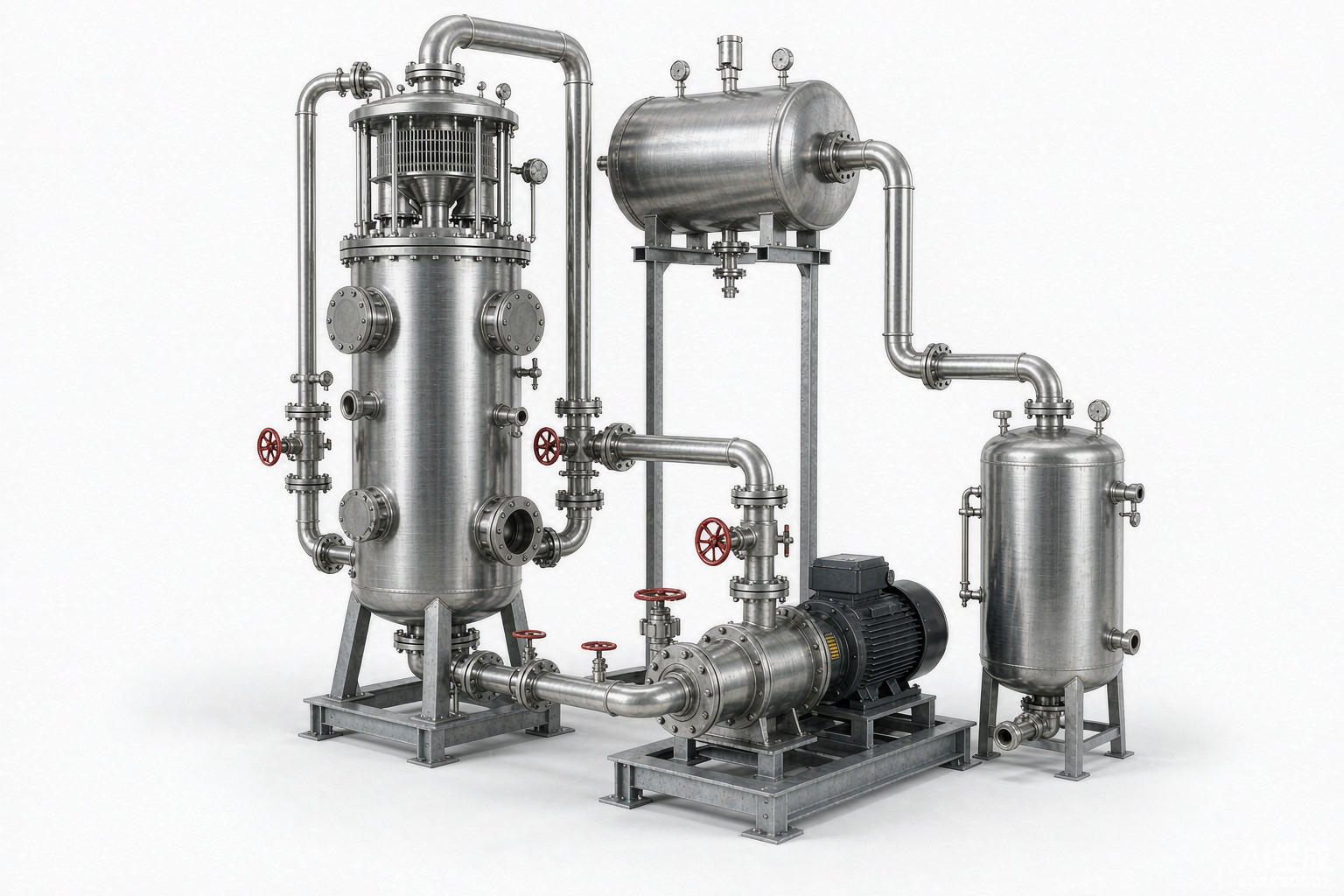
Check site readiness and validation needs
Confirm utilities, electrical capacity, heat rejection or cooling arrangements, ventilation, drainage, footprint, maintenance access, automation, sampling, and operator responsibilities. Document the feed conditions assumed in the review and identify the uncertainty with the greatest effect on selection. Representative sampling, compatibility review, bench work, or pilot evaluation may be appropriate where variability or residual behavior is uncertain.
For industrial solution context, seeFC Series vacuum heat pump evaporator . These internal pages describe public product-family, solution, or application context only; suitability requires a feed-specific review.
Conclusion
A credible evaluation starts with a defined feed, a clear operating objective, and viable routes for every outlet. By using the screening parameters above, project teams can decide whether a concentration-related step deserves further validation and which questions must be answered before selecting equipment.
References
1. VIFLUTER. *Public product, solutions, and industry pages*. Accessed 2026-10-28. industrial vacuum evaporator guide | FC Series vacuum heat pump evaporator | contact VIFLUTER.
2. U.S. Environmental Protection Agency. *Supplemental Technical Development Document for Proposed Revisions to the Effluent Limitations Guidelines and Standards for the Steam Electric Power Generating Point Source Category*. Available at: https://nepis.epa.gov/Exe/ZyPURL.cgi?Dockey=P100Y0J1.txt. Accessed 2026-10-28.
3. Scope note: The existing VIFLUTER industrial vacuum evaporator guide is the page owner for this topic; this update-style article should be consolidated with that page rather than published as a competing URL. EPA material is cited only for general background on thermal treatment and concentrate handling.