
 | marketing@wsdks.com |  | +8617712621386 |  | No. 8 Jinwei Road, Changshu City, Jiangsu Province, P.R.China |


Vacuum Evaporator for Electroplating Wastewater: Complete Treatment Solution
Electroplating wastewater is one of the hardest streams anevaporator will ever see. Complexing agents in zinc-nickel alloy baths keepmetals stubbornly dissolved. Chromium exists in two oxidation states withdifferent treatment chemistries. And the industry's discharge standards keeptightening. Here's how vacuum evaporation fits — and where it doesn't.
Why Electroplating Wastewater Breaks TraditionalTreatment
Traditional physico-chemical treatment — pH adjustment,coagulation, flocculation, sedimentation — works reasonably well forsingle-metal streams at moderate concentrations. It falls apart withzinc-nickel alloy wastewater. The complexing agents (EDTA, citrate,ammonia-based) that keep nickel and zinc stable in the plating bath alsoprevent hydroxide precipitation. The result: treated effluent that still reads5-10 mg/L nickel when the discharge limit is 0.1 mg/L.
This isn't a chemical dosing problem. It's a fundamental limitationof precipitation chemistry in the presence of strong chelating agents. You canthrow more chemicals at the problem — and many plants do — but the costescalates while compliance remains inconsistent.
How Vacuum Evaporation Handles Complexed Metals
An evaporator doesn't react with the nickel — it removes the water,leaving the nickel behind. Complexing agents, dissolved solids, organicbrighteners, and metals all concentrate together in the brine. The chemistry ofthe wastewater doesn't matter to the evaporation process; it matters for howfar you can concentrate before scaling or viscosity becomes a problem.
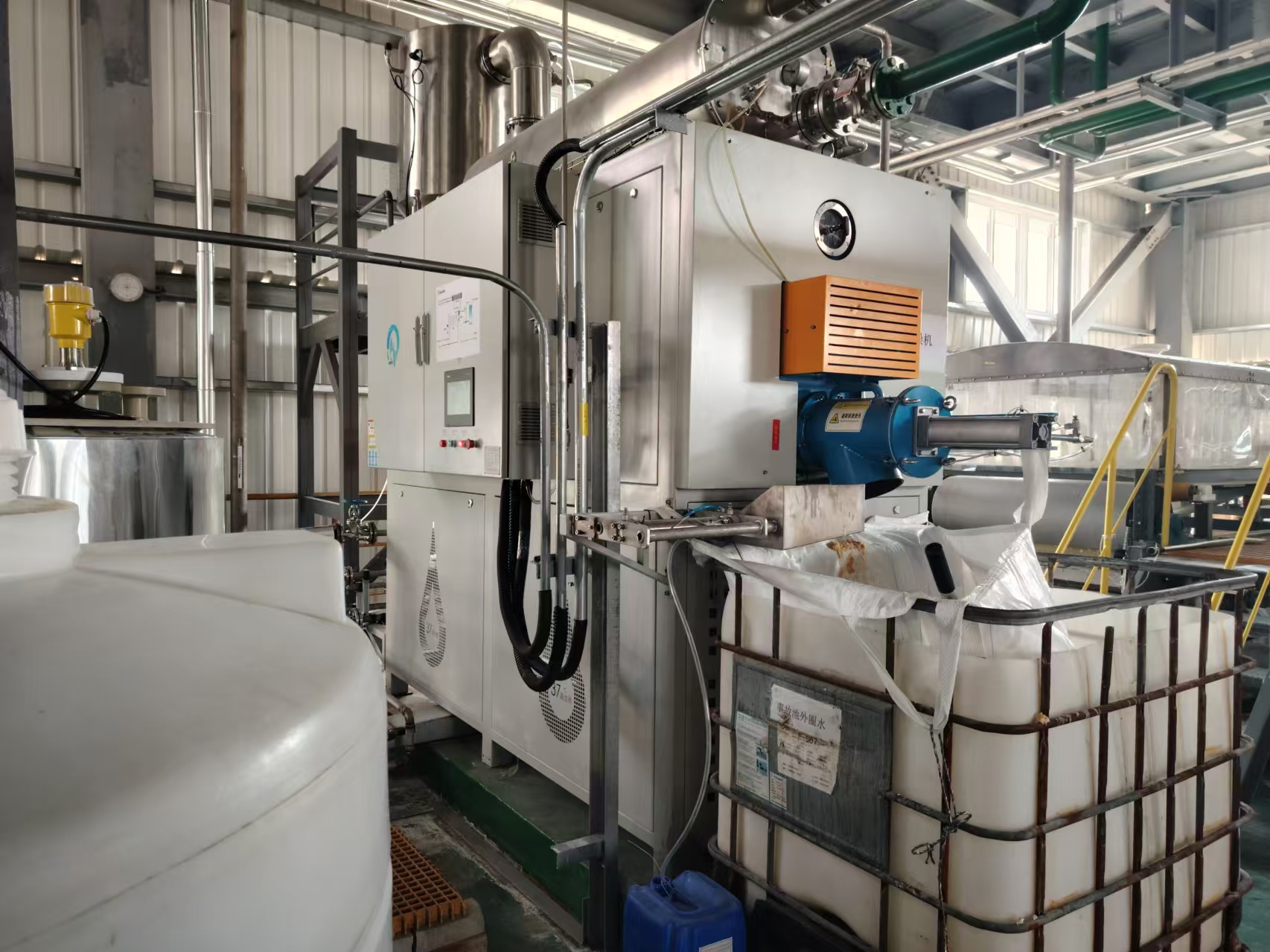
In a VIFLUTER system treating zinc-nickel alloy rinse water, thefeed enters at roughly 3 g/L nickel concentration. After vacuum evaporation at40-50°C under forced circulation, the nickel content in the distillate measuresbelow 0.1 ppm — more than four orders of magnitude reduction. The concentrate,at roughly 18% moisture, goes to a licensed hazardous waste handler or, in somecases, to a metal recycler who recovers the nickel value.
Chromium: The Two-Form Problem
Hexavalent chromium (Cr⁶⁺) requires reduction to trivalent chromium(Cr³⁺) with sodium metabisulfite or ferrous sulfate at pH 2-3 beforeevaporation. Skip this step, and Cr⁶⁺ will carry over in the distillate becausechromate ions are volatile under certain conditions. The reduction step musthappen before the water reaches the evaporator — it's a pretreatmentrequirement, not optional.
Once reduced to Cr³⁺, chromium behaves like any other trivalentmetal: it concentrates in the brine and leaves the distillate at sub-ppmlevels, assuming proper demisting. A dedicated demister pad and adequatefreeboard in the separation tank are essential for chromium-bearing streams.
From Treatment to ZLD: Closing the Loop
For electroplating facilities facing zero liquid dischargemandates, the evaporator is step two in a three-step chain: pretreatment (hexchrome reduction, filtration) → evaporation (volume reduction, distillaterecovery) → crystallizer or dryer (solid waste production). The VIFLUTERapproach uses vacuum heat pump evaporation for the main volume reduction,producing 90-95% distillate recovery, followed by scraped-surface drying orcrystallization for the residual concentrate.
The reclaimed distillate — with nickel, chrome, and copper allbelow detection limits — returns to the rinse tanks. The only waste stream is asmall volume of solid or semi-solid salt residue that is economically viable toprocess off-site.
What to Watch For
Not every electroplating stream belongs in an evaporator. Highlyacidic baths (pH below 2) require neutralization first. Sludge-heavy streamswith suspended solids above 1% need pre-filtration. And mixed streamscontaining both cyanide and acid must never be combined — that's a safetyissue, not an equipment limitation. Send VIFLUTER your rinse water analysis,including the specific plating chemistry and complexing agents used, for atreatability assessment.