
 | marketing@wsdks.com |  | +8617712621386 |  | No. 8 Jinwei Road, Changshu City, Jiangsu Province, P.R.China |


Industrial Wastewater Treatment: How to Scope a Concentration and ZLD Evaluation
Industrial wastewater treatment is a feed-specific engineering problem. A plant may need volume reduction, water reuse support, concentrate management, or a broader zero liquid discharge (ZLD) evaluation. The right starting point is to define the water, its variability, and every outlet that the project must manage.
Set the project boundary first
A concentration or ZLD evaluation should not begin with a technology name. It should begin with an agreed system boundary: which streams are included, what treatment objective applies to each, and which residual routes are available on site or off site.
A practical review maps every inlet and outlet: wastewater feed, separated solids or oil, treated water or condensate, concentrate, cleaning liquids, and any final solids. For each outlet, name the next destination and the operating condition it must meet. This prevents the project from simply moving the treatment burden to a later step.
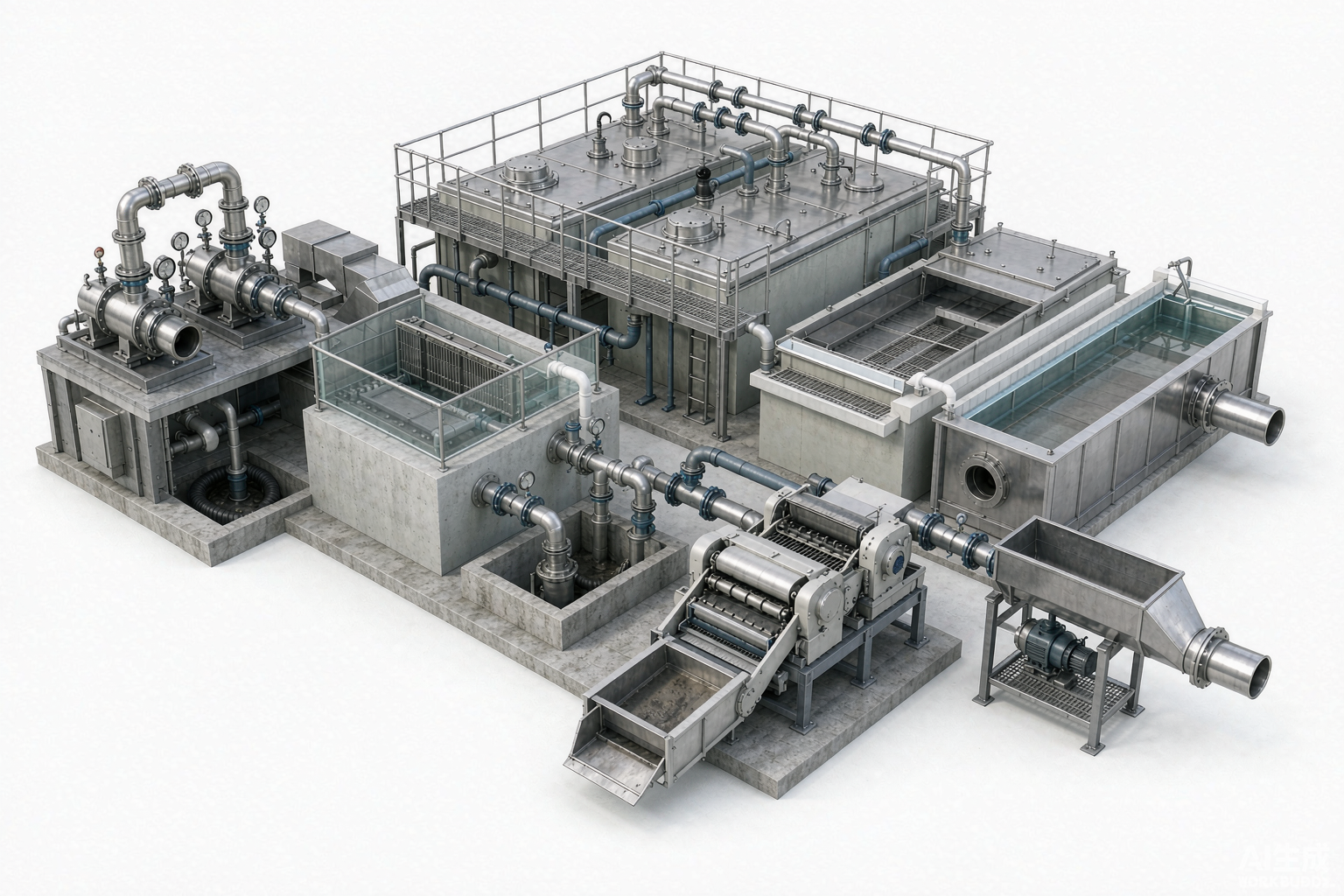
Parameters to confirm before selecting a route
The following table is a screening aid. It is not a specification sheet or a substitute for representative sampling and engineering review.
Project-scoping parameters
Parameter | Data to collect | Why it matters |
Flow pattern | Average, peak, batch and seasonal flow | Determines equalization and operating schedule |
Feed composition | Salts, solids, oil, organics, pH and volatile constituents | Defines pretreatment and concentration constraints |
Water destination | Reuse, polishing, discharge or internal return | Sets downstream water-quality requirements |
Residual route | Concentrate, sludge, crystals and cleaning effluent | Prevents burden transfer downstream |
Site boundary | Utilities, footprint, drainage, access and labor | Tests whether the concept is operable |
Evaluate pretreatment, concentration, and residuals as one train
Pretreatment may be required before a concentration stage can be evaluated. Depending on the stream, teams may need to consider equalization, separation of free oil or solids, pH control, removal of interfering constituents, or other conditioning steps. The appropriate sequence depends on actual feed behavior and the intended treatment objective.
If evaporation or crystallization is considered, review scaling, fouling, foam, viscosity, corrosion, volatile constituents, cleaning needs, and solids formation as water is removed. Then define the destination of condensate and the route for concentrate, mother liquor, sludge, or solids. A concentration step is only one part of a complete process boundary.
Check site readiness and validation needs
Confirm utilities, electrical capacity, heat rejection or cooling arrangements, ventilation, drainage, footprint, maintenance access, automation, sampling, and operator responsibilities. Document the feed conditions assumed in the review and identify the uncertainty with the greatest effect on selection. Representative sampling, compatibility review, bench work, or pilot evaluation may be appropriate where variability or residual behavior is uncertain.
For industrial solution context, see solutions overview | industries served | contact VIFLUTER. These internal pages describe public product-family, solution, or application context only; suitability requires a feed-specific review.
Conclusion
A credible evaluation starts with a defined feed, a clear operating objective, and viable routes for every outlet. By using the screening parameters above, project teams can decide whether a concentration-related step deserves further validation and which questions must be answered before selecting equipment.
References
1. VIFLUTER. *Public product, solutions, and industry pages*. Accessed 2026-10-28. solutions overview | industries served | contact VIFLUTER.
2. U.S. Environmental Protection Agency. *Supplemental Technical Development Document for Proposed Revisions to the Effluent Limitations Guidelines and Standards for the Steam Electric Power Generating Point Source Category*. Available at: https://nepis.epa.gov/Exe/ZyPURL.cgi?Dockey=P100Y0J1.txt. Accessed 2026-10-28.